Shot 1: Long Shot- Person walks down a corridor and through a door. Then the door shuts.
Shot 2: Close Up- Door handle- person walks up to the door, turns handle and goes through.
Shot 3: Medium Long Shot- Person walks up to the door, goes through and sits down.
Shot 4: Medium Two Shot- Both people, one person walks into the shot, sits down and goes through the conversation all the way through.
Shot 5: Medium Close Up- Walks through sits down and conversation all the way through.
Shot 6: Medium Close Up- Other persons shoulder at the other angle and the conversation all the way through.
Shot 5 and 6 use shot reverse shot too. Also we have to make sure that the conversation is edited right so we have many shots with this in. Match on Action also has to be done right when the close up of the door handle is being done and whilst sitting down.
Friday, 29 November 2013


Shots.
Hollie-Marie Knowlton
180 degree line of action-
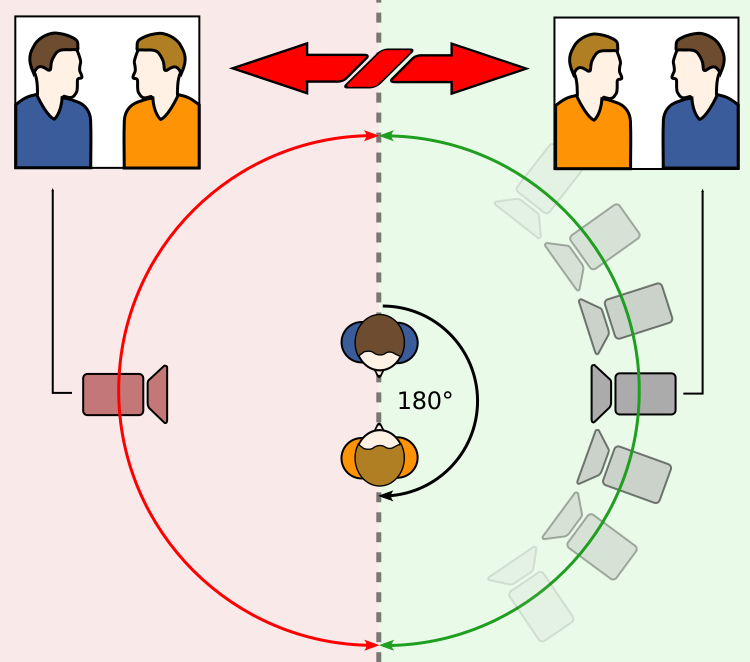
This is when there is an 'imaginary' line across a whole shooting of a scene and you have to stay at one side of the line to make sure that the continuity is right. This is a role that the actor/actresses have to have but as well as the camera men .
For example, if the character in blue is on the right in one scene and somebody in red is on the left this is how it should stay throughout the shot anf film. However, if this is the opposite in another scene it can confuse the audience and adds a ‘jumpy’ sort of feel to the scene.

Shot Reverse Shot- This is when one character is shown looking at another character (often off-screen), and then the other character is shown looking back at the first character. The characters are shown facing in opposite directions; the audience assumes that they are looking at each other. Also, this is key in a film for a conversation as you can follow what is being said at what time.
Match on Action- Match on action is a very simple and effective for a scene and this is where the perspective of the camera changes during a shot and the scene continues to flow. This also helps continuity when editing.
180 degree line of action-
This is when there is an 'imaginary' line across a whole shooting of a scene and you have to stay at one side of the line to make sure that the continuity is right. This is a role that the actor/actresses have to have but as well as the camera men .
For example, if the character in blue is on the right in one scene and somebody in red is on the left this is how it should stay throughout the shot anf film. However, if this is the opposite in another scene it can confuse the audience and adds a ‘jumpy’ sort of feel to the scene.

Shot Reverse Shot- This is when one character is shown looking at another character (often off-screen), and then the other character is shown looking back at the first character. The characters are shown facing in opposite directions; the audience assumes that they are looking at each other. Also, this is key in a film for a conversation as you can follow what is being said at what time.
Match on Action- Match on action is a very simple and effective for a scene and this is where the perspective of the camera changes during a shot and the scene continues to flow. This also helps continuity when editing.
Thursday, 14 November 2013
Storyboard


Friday, 20 September 2013
Shot-Reverse-Shot
Shot-Reverse-Shot is a film technique where one character is shown looking at the other and vice-versa. After that, the characters are shown facing opposite directions. The viewer subconsciously assumes that the characters are looking at each other when in actual fact, they aren’t.

180 Degree Line Of Action
If you're shooting a short film or interview, it's important to set the scene and your characters in a space and time in order for the viewer to follow the action. One of the most basic continuity rules is the 180 Degree Rule. The 180 Degree Rule means that two characters in a scene should always have the same left/right relationship to each other. If you don't follow the 180 Degree Rule it disrupts the scene confuses the audience. When you break the 180 line, a person who was originally facing left in a scene is all of the sudden facing right, it makes it look like they've swapped places.
Match on Action
A match
on action is a technique used in film editing.
Its a cut that connects two different views of the same action
at the same moment in the movement. By carefully matching the movement across
the two shots, filmmakers make it seem that the motion continues
uninterrupted. For a real match on action, the action should begin in the first
shot and end in the second shot.
Video example of match on action
Subscribe to:
Posts (Atom)